
The UK ZEV Mandate Explained
The UK ZEV Mandate Explained: What It Is, How It Works and What It Means for Fleets

The UK Zero Emission Vehicle (ZEV) Mandate can sound like a fleet purchasing rule. It is not. It sets annual requirements for vehicle manufacturers, not for the businesses and drivers who buy or lease their vehicles.
That distinction matters. The mandate can still affect the models manufacturers offer, the discounts they use to encourage electric vehicle sales and the availability of vehicles. But it does not require your business to buy electric.
Here’s how the rules work, what changed, and what to consider when planning your fleet.
What is the ZEV Mandate?
Introduced in January 2024, the ZEV Mandate forms part of the UK’s Vehicle Emissions Trading Schemes (VETS).
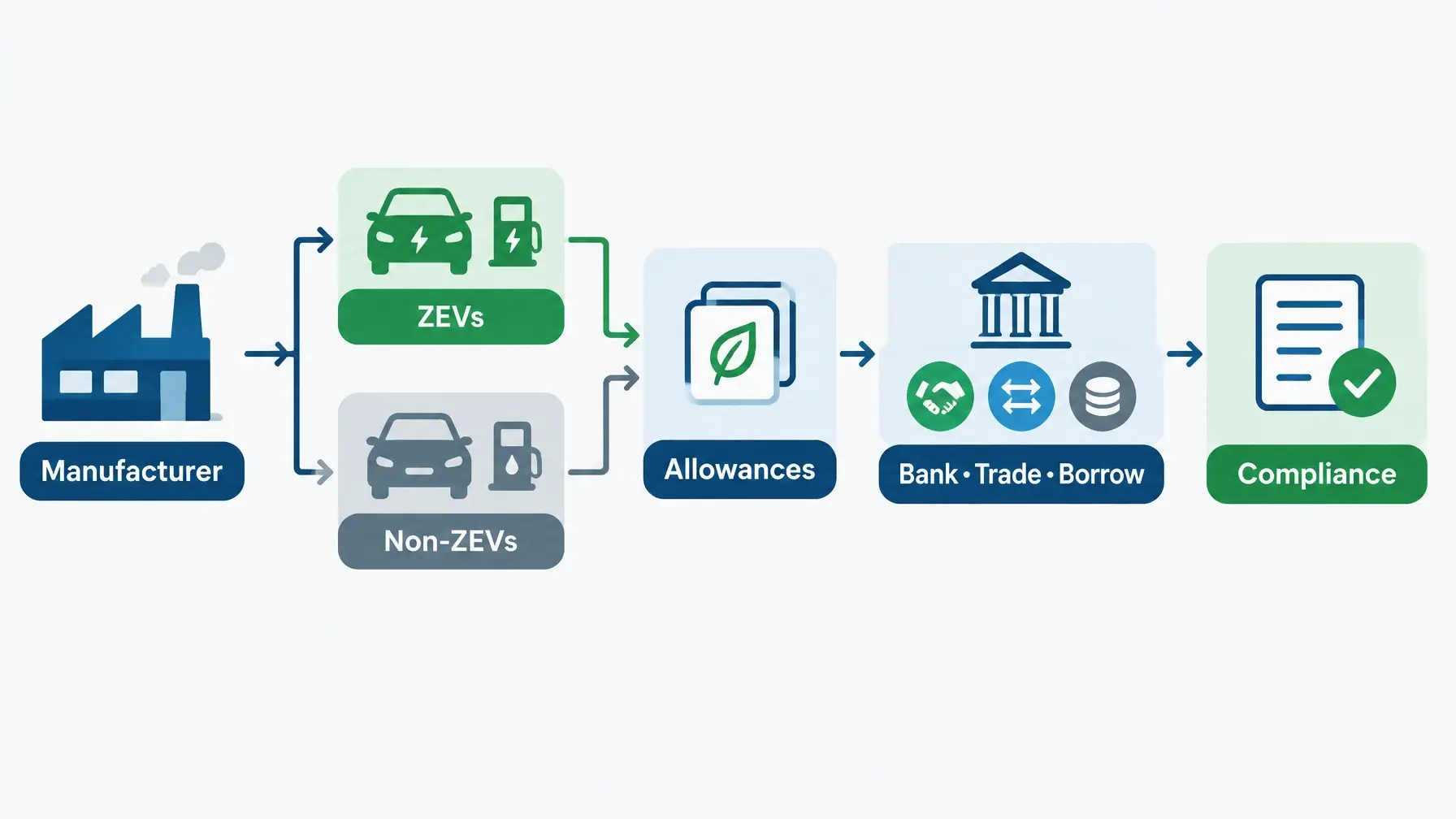
It requires each manufacturer to meet a rising annual share of zero-emission new car and van registrations in the UK. In practice, the mandate operates through allowances: manufacturers receive allowances for non-zero-emission registrations and must account for the vehicles they register.
The policy is part of the transition towards zero-emission new vehicles. The current trajectory sets an 80% ZEV target for new cars and 70% for new vans in 2030, rising to the goal of 100% zero-emission new cars and vans by 2035. The 2030 commitment for cars concerns vehicles relying solely on an internal combustion engine; it is not the same as a requirement for every new car to be a battery electric vehicle by then.
The mandate applies to manufacturers, not fleet operators or drivers. Your business is not required by the ZEV Mandate to buy or lease an electric vehicle.
What are the annual car and van targets?
The current statutory targets are:
These are manufacturer-level targets, not a quota for each fleet. The legal target is also not a simple instruction that the stated proportion of each manufacturer’s vehicles must be electric with no other route to compliance. The trading scheme allows manufacturers to use specified allowances, credits and flexibilities.
There are separate car and van schemes, but no separate ZEV percentage targets for small and large vans. Nor does a longer-range electric vehicle automatically count as multiple ZEV registrations.
How does the ZEV Mandate work?
The mechanism can be easier to understand through the non-ZEV allowances. In 2026, the 33% car target means that a manufacturer receives allowances covering the other 67% of its new car registrations. It must surrender an allowance for each non-ZEV car it registers. If it registers more non-ZEVs than its allowances cover, it has a shortfall to address.
Simple example: suppose a manufacturer registers 100,000 cars in 2026. Its target corresponds to 33,000 ZEVs and 67,000 non-ZEV allowances. If it registers 25,000 ZEVs, it has 75,000 non-ZEV registrations-8,000 more than its initial non-ZEV allowances cover. It can seek to resolve that shortfall using permitted routes such as trading, borrowing or conversion, subject to the rules. If it cannot, a compliance payment may apply.
This is an illustration of the basic idea, not a manufacturer’s final compliance calculation. The rules include additional provisions and conditions.

What do banking, trading and borrowing mean?
Manufacturers that have surplus allowances may be able to bank them for use in a later year; banked allowances can be used for up to three years. They may also trade eligible allowances with other manufacturers.
Borrowing allows a manufacturer to use some of its future allowance allocation to address a current shortfall. It is subject to annual limits, carries 3.5% compound interest and must be repaid by 2030. These are compliance tools for manufacturers, not obligations or options available to fleet operators.
Can hybrids or other vehicles help manufacturers comply?
The wider VETS rules include CO₂ trading schemes alongside the ZEV schemes. Where a manufacturer has surplus CO₂ allowances, it may be able to convert some of that compliance into ZEV-scheme allowances, within the applicable limits. Efficient non-ZEV vehicles, including some hybrids, can therefore contribute to a manufacturer’s compliance position through the CO₂ rules. They do not count as zero-emission vehicles.
The schemes also award specific credits for eligible vehicles or uses, such as certain special-purpose vehicles and qualifying car-club sales. The detail depends on the scheme and the vehicle.
There are exemptions and derogations for some low-volume manufacturers. For example, manufacturers registering fewer than 1,000 cars or vans a year receive a micro-volume treatment; some manufacturers below 2,500 registrations may apply for a derogation, subject to conditions.
The government’s VETS guidance sets out the detailed compliance rules. For unresolved ZEV allowance shortfalls, the current compliance payments are £12,000 per car and £15,000 per van.
What changed in 2025?
In April 2025, the government kept the headline ZEV target trajectory but expanded manufacturers’ compliance flexibilities. Changes included extending borrowing and CO₂ conversion routes, introducing transfers between the car and van ZEV schemes, and reducing the compliance payment rates from those originally set for later years.
The practical result is that the headline percentages do not tell the whole story about manufacturer compliance. The underlying targets remain important, but the rules provide additional ways to address a shortfall. Those flexibilities are subject to limits and repayment or conversion conditions; they do not make the targets irrelevant.
How close are registrations to the 2026 targets?
The latest data available at the time of writing show a different picture for cars and vans. According to SMMT registration data, battery electric vehicles (BEVs) made up around 26.2% of new car registrations from January to September 2026, compared with the 33% car target.
For vans, BEVs accounted for around 10.8% of new light commercial vehicle registrations over the same period, against the 24% target. The monthly share reached a record 14.7% in July, but monthly peaks do not change the year-to-date picture. See the SMMT’s van-market reporting.
These market shares are useful context, but they are not the same as a compliance calculation for an individual manufacturer. The mandate includes flexibilities and is assessed under its own rules.
What did the 2026 review consider?
The government’s ZEV Mandate review consultation opened on 14 August 2026 and closed on 23 October. It asked for views on the targets and the compliance system.
Options included reducing the 2030 van target from 70% to 60%, 50% or 40%, and lowering the 2030 car target from 80%, with options extending as low as 50%. The consultation also considered keeping the headline targets while extending flexibilities such as banking, borrowing and CO₂ conversion through 2034.
Current status as of November 2026: the consultation has closed, but the government response has not yet been announced. The proposals are not changes to the rules. The 2026 statutory targets remain 33% for cars and 24% for vans unless and until the law changes.
What does the mandate mean for your fleet?
Although the mandate does not impose a purchasing requirement on your business, it may shape the market you buy from. Manufacturers’ efforts to meet their targets can influence EV discounts, allocation and stock availability. Changes in incentives or supply can affect the relative cost of electric and combustion-engine vehicles. Over time, changing supply and demand may also influence used-vehicle values and residual assumptions.
For your fleet, the sound approach is to treat future targets and market conditions as scenarios, not as a reason to make a one-size-fits-all switch. Assess each vehicle against its actual duty cycle: mileage, routes, payload, charging access and driver needs. Then compare whole-life costs, including energy, maintenance, insurance, finance and infrastructure.

A practical transition plan should support your business’s net zero fleet ambitions without compromising service or cost control. Our fleet electrification service can help you assess vehicle suitability, charging requirements and the financial case.
The ZEV Mandate is complex, but its immediate message for fleets is straightforward: you are not required to buy electric, and the best vehicle choice still depends on your operation. Let’s talk if you’d like to assess the options and model the whole-life costs for your fleet.
This article explains the policy for general information and is not legal advice. The mandate and market data may change; check the linked government and SMMT sources for current information.