
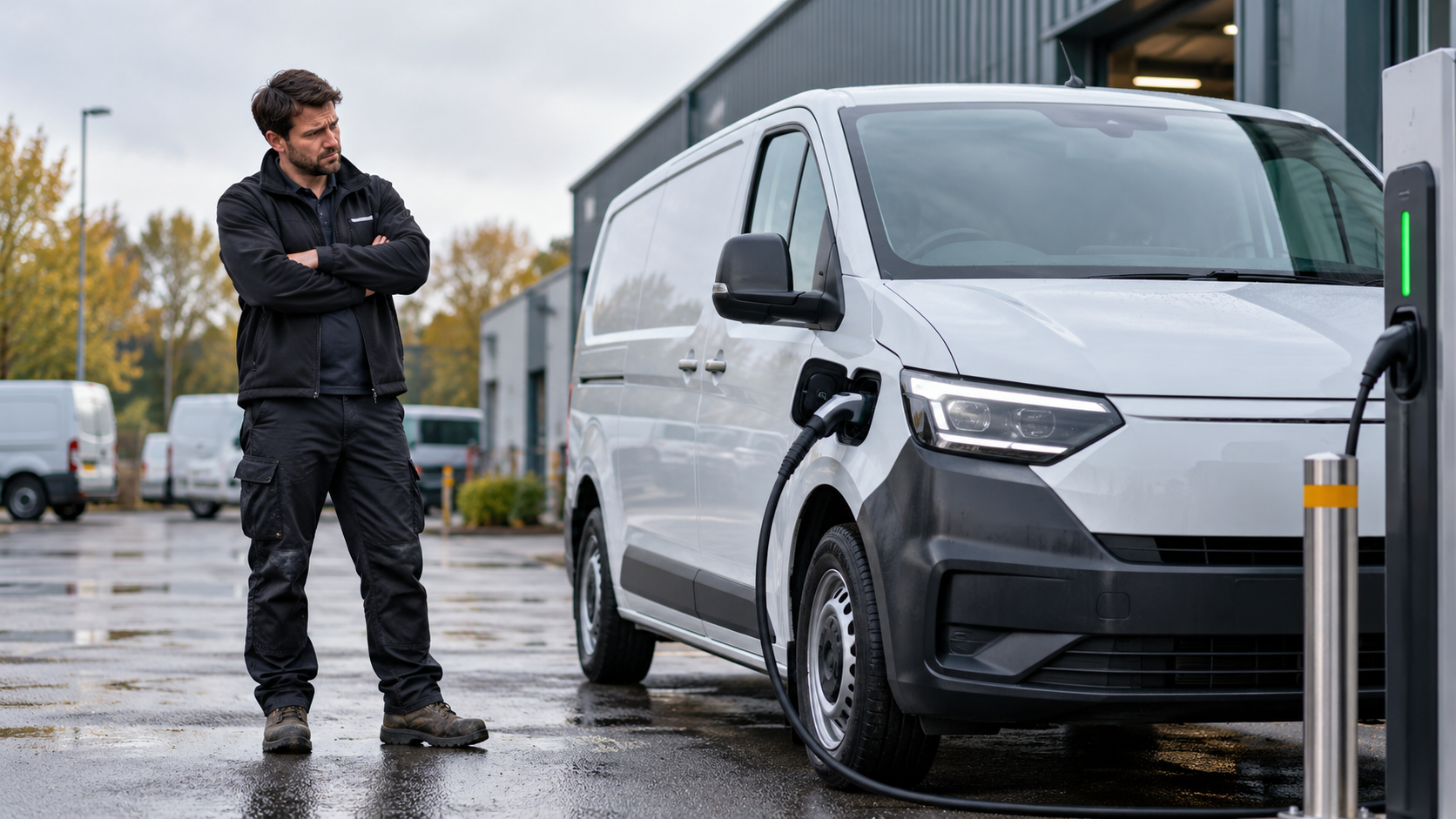
Electric Vans: What's in It for the Driver?
Electric Vans: What's in It for the Driver? The Incentives and Disincentives of Fleet Electrification
Fleet electrification promises lower emissions and potentially lower operating costs for businesses. But what does it offer the employees who actually drive the vans? Unless businesses address the imbalance between corporate benefits and driver inconvenience, resistance to electrification should come as no surprise.
The Missing Piece in Fleet Electrification
Across the UK, businesses are under increasing pressure to reduce their carbon emissions and transition their commercial vehicle fleets from diesel to electric.
For fleet managers, the business case can be compelling. Electric vans can reduce Scope 1 emissions, contribute towards corporate net-zero targets and potentially deliver savings in energy and maintenance costs.
But there is a question that is frequently overlooked:
What's in it for the driver?
For an electrician, engineer, maintenance operative or delivery driver, an electric van is not primarily an environmental initiative. It is a tool they rely on to do their job.
If changing that tool introduces additional inconvenience, uncertainty or personal expense, why should they welcome the change?
This creates a fundamental challenge for fleet electrification programmes: the employer receives many of the benefits, while the employee may experience many of the disadvantages.
And even when employers successfully remove those disadvantages, the driver may be no better off than before.
The Employer's Business Case Is Not the Driver's Business Case
From an organisational perspective, electrifying a commercial vehicle fleet can deliver several benefits:
- Reduced direct carbon emissions.
- Progress towards net-zero commitments.
- Potentially lower energy costs per mile.
- Reduced maintenance expenditure.
- Improved environmental credentials.
- Compliance with fleet decarbonisation policies.
- Potential savings in total cost of ownership (TCO).
These are legitimate commercial and environmental benefits.
However, they do not automatically translate into benefits for the person operating the vehicle.
Consider a driver who currently takes a diesel van home every evening.
They can refuel in a few minutes, know approximately how far the vehicle will travel on a tank and rarely need to consider how their next day's work might affect their ability to refuel.
Switching to an electric van could introduce new considerations. Is there sufficient charge for tomorrow's jobs? Will the vehicle need charging during the working day? What happens if a charger is unavailable? Who pays for the electricity used at home?
The employer might save hundreds or thousands of pounds annually, but the driver may see little personal advantage.
This is where resistance to change can begin.
The Disincentives: Why Drivers May Resist Electric Vans
1. Charging Time and Lost Productivity
Refuelling a diesel van is generally a quick and familiar process. Charging an electric van can take considerably longer, depending on the battery, charger and required energy.
Where vehicles can charge overnight at a depot, this may be of little consequence.
However, for field-based employees who take their vans home or travel significant distances, charging can become an additional responsibility.
A driver who needs to spend 30 minutes a week managing charging outside normal working hours could potentially lose 26 hours of personal time over a year.
Even if the employer saves money, the employee may feel they are effectively working additional unpaid hours.
The question for employers is whether charging time should be treated as a business responsibility rather than a personal inconvenience.
Charging required for work should be planned and accounted for appropriately, with working-time arrangements agreed rather than assumed.
2. Using the Employee's Home Electricity
Home charging is often presented as one of the most practical solutions for electric commercial vehicles.
For employees with suitable off-street parking, it can offer genuine convenience. However, it can also raise important questions.
Who pays for installing the charger? How is the electricity measured? Will the employee have to pay the electricity bill before being reimbursed? What happens when energy tariffs change?
There is also the question of whether employees should be expected to use their own property and domestic electricity infrastructure to support their employer's fleet operations.
Smart charging and direct billing arrangements can resolve many of these issues, but they need to be established before the vehicle is delivered.
Simply reimbursing an employee for electricity they have purchased does not constitute a financial incentive. It merely prevents them from subsidising their employer's operating costs.
3. No Driveway, No Easy Solution
Not every employee has access to off-street parking.
Drivers living in terraced properties, flats or rented accommodation may be unable to install a domestic charger.
For these employees, electrification may mean relying on public charging infrastructure, with additional journeys, uncertain availability and potentially significant charging time.
There is also a risk of creating an unfair two-tier workforce.
Employees with driveways may benefit from convenient overnight charging, while colleagues without suitable parking face considerably greater disruption.
A fair fleet electrification programme needs to account for these differences rather than applying a single solution to every driver.
4. Range Anxiety and Operational Uncertainty
Commercial vehicle drivers often carry tools, equipment, materials or other significant loads.
Their daily mileage may also vary considerably.
Vehicle range can be influenced by payload, weather conditions, driving style, heating requirements and motorway use.
Modern electric vans are increasingly capable, and many operational routes are well within their practical range. Nevertheless, the driver needs confidence that the vehicle will reliably complete the required work.
A driver who believes their vehicle might prevent them from completing the day's jobs is unlikely to support the change enthusiastically.
This is particularly important where employees are measured against productivity, job completion or customer service targets.
Employers cannot reasonably expect drivers to accept responsibility for delays caused by a vehicle or charging arrangement that is unsuitable for the task.
5. Responsibility Without Control
Perhaps the most overlooked disincentive is the transfer of operational responsibility.
With a diesel van, the employer supplies a vehicle and typically pays for fuel.
With an electric van, the employee may also become responsible for planning charging, monitoring battery levels, operating a home charger, managing reimbursement claims and adapting journeys.
The organisation has made a strategic decision to electrify, but the driver is expected to make that decision work in practice.
If something goes wrong, it may be the driver who faces the immediate consequences.
Why should employees carry additional responsibility for a decision primarily designed to benefit the business?
Are There Any Genuine Benefits for Drivers?
It would be wrong to suggest electric vans offer drivers no advantages.
Depending on the vehicle and operating environment, they can offer several worthwhile improvements.
Electric vans generally provide smoother acceleration, quieter operation and less engine vibration.
For drivers operating in congested urban environments or making frequent stops, these characteristics can make the working day more comfortable.
Home charging can also be convenient where a suitable charger is available. A driver who plugs in overnight and starts every morning with sufficient range may never need to visit a fuel station.
Some employees may also value contributing towards reducing emissions and improving local air quality.
There can be personal tax advantages in certain circumstances. Zero-emission company vans benefit from a nil van benefit charge, whereas the standard taxable van benefit for unrestricted private use of a conventional van is £4,170 in the 2026/27 tax year.
However, this advantage may be irrelevant to many operational van drivers whose existing diesel vehicles are already exempt from the van benefit charge because their private use is restricted.
In those cases, switching to electric produces no additional van benefit tax saving.
The challenge is that these advantages are not equally valuable to every employee and may be outweighed by the inconvenience of charging.
Being No Worse Off Is Not the Same as Being Better Off
This distinction should be central to every commercial fleet electrification programme.
Many employers focus on ensuring that drivers are not financially disadvantaged when switching to electric.
They might provide a home charger, reimburse electricity costs and offer access to public charging.
These are sensible and necessary measures.
But they are not necessarily incentives.
They simply remove some of the disadvantages created by the transition.
Consider an employee who previously operated a diesel van without any personal expenditure or charging responsibilities.
After switching to electric, they receive full reimbursement for electricity and a company-funded home charger.
Financially, they are in approximately the same position as before.
However, they now have additional charging responsibilities and may experience greater uncertainty when planning their working day.
From the employee's perspective, the best-case outcome might be that they are no worse off. The worst-case outcome is that they lose time, convenience and flexibility.
Neither scenario provides a particularly compelling reason to embrace change.
If businesses genuinely want driver support, they should consider how employees can benefit directly from electrification.
Sharing the Benefits: What Could Employers Offer?
One approach would be to share some of the financial savings generated by electrification with the employees responsible for making it work.
For example, imagine a business calculates that replacing a diesel van with an electric alternative will save £1,200 annually in total operating costs, before any driver incentive.
Instead of retaining the entire saving, the business could introduce a driver incentive worth £30 per month.
This would provide an additional £360 in gross annual earnings for the employee while retaining £840 of the original estimated saving before employer payroll costs.
The figures are illustrative, and actual savings will depend on mileage, energy tariffs, lease costs, maintenance, charging infrastructure and operational requirements.
The principle, however, is straightforward.
If employees are expected to change their behaviour to deliver savings for the organisation, there is a reasonable argument for sharing some of those savings with them.
A Practical Electric Van Driver Incentive Package
| Measure | Purpose |
|---|---|
| Fully funded home charger | Removes the employee's upfront installation cost |
| Automatic electricity reimbursement | Ensures drivers do not subsidise business energy use |
| £25–£50 monthly EV allowance | Provides a tangible financial reward |
| Paid charging time where required | Protects employees from additional unpaid responsibilities |
| Employer-funded public charging | Avoids personal spending and complicated expense claims |
| Guaranteed replacement vehicle | Removes concerns about unsuitable routes or charging failures |
| Driver involvement in vehicle selection | Improves suitability and builds confidence |
| Training and ongoing support | Helps drivers adapt to electric vehicles |
| Recognition or efficiency incentives | Rewards engagement without penalising drivers for operational factors outside their control |
Any cash allowance should be assessed for income tax and National Insurance implications.
Crucially, a fair incentive scheme must not disadvantage employees who are unable to charge at home or whose operational requirements make an electric van unsuitable.
What Would Driver Incentives Cost a Fleet?
Consider a fleet of 100 electric vans, each with an illustrative £1,200 annual operating cost saving before driver incentives.
The organisation could choose to share 30% of those savings with drivers.
| Measure | Annual amount |
|---|---|
| Gross operational savings across 100 vehicles | £120,000 |
| Driver incentives at £360 per vehicle | £36,000 |
| Remaining savings before employer payroll on-costs | £84,000 |
At the individual level, the driver would receive £30 a month in additional gross pay.
That may not seem substantial, but it changes the nature of the proposition.
Instead of asking employees to accept inconvenience for the benefit of their employer, the business is offering a measurable personal reward.
Whether £30 is sufficient will depend on the actual inconvenience experienced. A driver who needs regular public charging or loses significant personal time may require a different arrangement.
A meaningful incentive package must therefore be based on real driver circumstances, not simply a standard payment applied across the fleet.
The Importance of Driver Consultation
Another common mistake is to introduce electric vehicles before properly understanding how employees use their existing vans.
Fleet telematics and mileage analysis are valuable tools, but they do not necessarily capture every aspect of the driver's experience.
A vehicle might travel only 70 miles per day on average, apparently making it ideal for electrification.
However, averages can conceal important operational requirements.
The driver may occasionally travel 200 miles, carry substantial equipment or need to respond to unexpected jobs.
They may also have no practical way to charge the vehicle overnight.
Before selecting vehicles, employers should engage directly with employees to understand their working patterns, home charging arrangements, concerns and preferences.
Pilot programmes involving representative drivers can be particularly valuable.
They allow businesses to identify problems before committing to a wider rollout and provide opportunities for employees to experience the benefits of electric vehicles first-hand.
The objective should be to demonstrate that electrification works for the driver as well as the employer.
Should Every Commercial Van Be Electric?
Not necessarily.
For many fleets, electric vans can deliver substantial environmental and financial advantages.
However, vehicle suitability should be determined by operational requirements, mileage, payload, charging arrangements and whole-life costs.
There may be legitimate reasons to retain diesel vehicles for certain applications while electrifying the remainder of the fleet.
Businesses should remember that fleet decarbonisation and fleet electrification are not identical objectives.
Reducing unnecessary mileage, improving vehicle utilisation and selecting more efficient vehicles can also contribute towards emissions reductions.
A successful strategy should identify where electrification delivers genuine benefits and where other measures may be more appropriate.
Forcing an unsuitable electric vehicle into an operation can create avoidable costs and undermine driver confidence in the wider transition.
How Let's Talk Fleet Can Help
At Let's Talk Fleet, we believe a successful electric commercial vehicle transition must consider three equally important factors:
Environmental performance: Will the transition deliver meaningful reductions in fleet emissions?
Commercial performance: Will the electric vehicles deliver an acceptable whole-life cost and maintain operational productivity?
Driver experience: Will employees be able and willing to operate the vehicles without unreasonable inconvenience or personal disadvantage?
Our independent fleet consultancy services help businesses evaluate electric vehicle suitability, analyse total cost of ownership, review operational requirements and develop practical fleet transition strategies.
We also recognise that driver engagement should be a core part of any electrification project.
A technically suitable electric van is of limited value if its charging arrangements disrupt operations or create unnecessary resistance among employees.
By combining operational analysis with practical driver consultation, businesses can develop transition strategies that deliver environmental benefits without compromising the workforce.
Conclusion: Electrification Needs to Work for the Driver, Not Just the Employer
The business case for electrifying commercial vehicle fleets is often presented in terms of lower emissions, reduced running costs and progress towards net-zero objectives.
But these are primarily benefits for the organisation.
For the driver, the transition may involve additional charging responsibilities, potential downtime, uncertainty and changes to established working practices.
Even when employers compensate employees for these disadvantages, the result may simply be that the driver is no worse off.
That is not necessarily a compelling incentive to change.
Businesses should therefore consider whether some of the financial and operational benefits of electrification can be passed on to employees.
This might involve financial incentives, improved working arrangements, more convenient charging or simply ensuring drivers have a meaningful voice in the transition.
The central question is simple: if electric vans save the business money and help it achieve its environmental objectives, what does the driver get in return?
Until fleet operators can provide a convincing answer, resistance to electrification should not be surprising.
After all, successful fleet electrification requires more than choosing the right vehicles. It requires giving the people who drive them a reason to support the change.
Planning an Electric Van Fleet Transition?
Let's Talk Fleet provides independent fleet consultancy, helping businesses assess electric vehicle suitability, whole-life costs, charging requirements and fleet operational efficiency.
We can help you develop a fleet decarbonisation strategy that balances environmental commitments with commercial performance and driver requirements.
Contact Let's Talk Fleet to discuss your fleet transition strategy.